
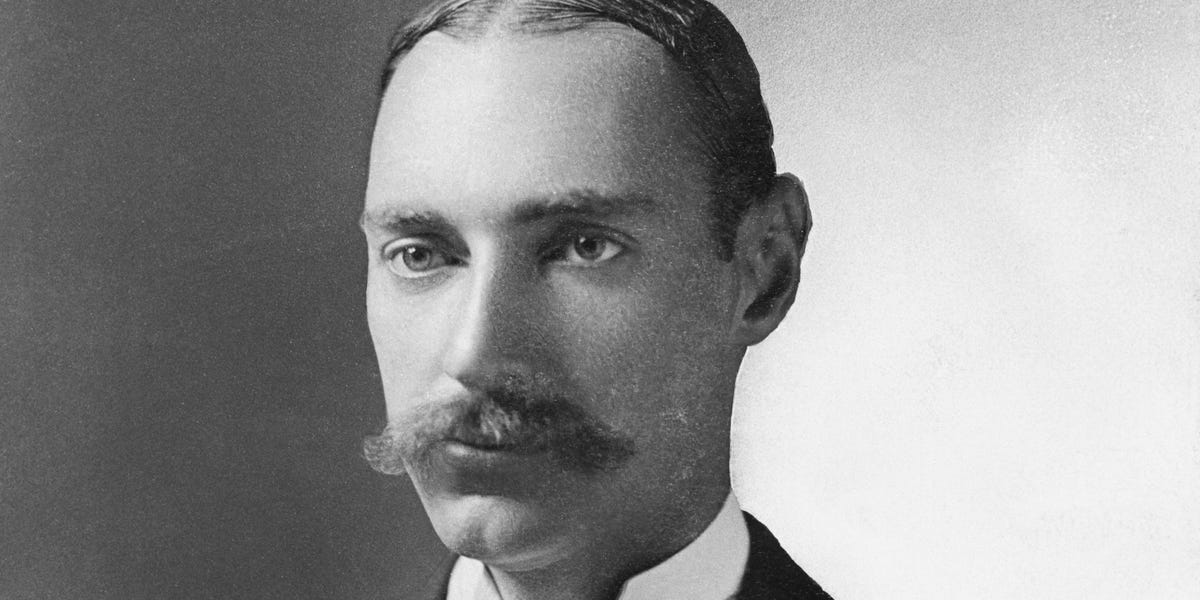
The name John Jacob Astor IV resonates through history not only for his immense wealth and social standing but also for his tragic end aboard the ill-fated RMS Titanic. As the wealthiest passenger on that maiden voyage in April 1912, his demise was a stark reminder of the unforgiving nature of the sea and the vulnerability of even the most privileged lives. This narrative delves into the life of a man who embodied the Gilded Age’s ambition and opulence, a life tragically cut short.
Born into a family that had already amassed a considerable fortune, John Jacob Astor IV inherited a legacy of enterprise and innovation. His grandfather, John Jacob Astor I, was the founder of the Astor family fortune, a business empire rooted in fur trading and later expanding into real estate, banking, and diversified investments. John Jacob Astor IV, however, was not content to merely rest on his family’s laurels. He was a man of diverse interests and a keen intellect, actively participating in and expanding the family’s business ventures.
His business acumen was evident in his early ventures. He played a significant role in the development of the Waldorf-Astoria Hotel, a symbol of New York’s grandeur and a testament to the Astor family’s influence. He was also involved in developing real estate in prime Manhattan locations, further solidifying the family’s position as major property owners. Beyond his business pursuits, Astor IV was an accomplished inventor, holding patents for various devices, including a bicycle brake and an improvement to the steam-turbine engine. This intellectual curiosity and drive for innovation set him apart, even within his privileged circle.
In 1911, at the age of 47, John Jacob Astor IV married Madeleine Force, who was significantly younger than him. Their marriage was a subject of public interest, partly due to the age difference and the subsequent pregnancy of Mrs. Astor. It was this young, pregnant wife who would become a central figure in the tragic narrative of his final moments. The couple boarded the Titanic in Southampton, England, on April 10, 1912, embarking on a transatlantic voyage that would tragically end just a few days later.
The sinking of the Titanic on the night of April 14-15, 1912, remains one of the most infamous maritime disasters in history. When the ship struck an iceberg in the North Atlantic and began to founder, the ensuing chaos and desperation were palpable. Despite his immense wealth and potential influence, Astor IV, like many others, found himself facing the grim reality of limited lifeboat capacity. Accounts from survivors paint a picture of his final actions. He was seen helping his wife into a lifeboat, ensuring her safety and that of their unborn child.
One of the most poignant accounts comes from witnesses who observed Astor IV bidding farewell to his wife. It is reported that he told her, “Good-bye, my dear. I am not going to get on that lifeboat, but I will be with you in the morning.” This dignified, albeit heartbreaking, farewell underscores his character in the face of insurmountable odds. He chose to remain on the sinking ship, a decision that ultimately cost him his life. His body was never recovered.
The loss of John Jacob Astor IV sent shockwaves through society. He was not just a symbol of wealth; he was a figure who had contributed to the nation’s economic and technological landscape. His passing left a void in his family and in the business world. His wife, Madeleine, survived the ordeal and later gave birth to their son, John Jacob Astor VI, who became known as “Jakey.” She remarried twice after Astor’s death, but the tragic circumstances of her first marriage and the loss of her prominent husband remained a significant part of her life story.
The story of John Jacob Astor IV serves as a powerful reminder of the fickle nature of fate. Here was a man who had commanded boardrooms, amassed fortunes, and dreamt of future innovations, only to be humbled by the immense power of nature. His life, before its brutal interruption, was a testament to the American Dream and the capabilities of ambitious individuals. His death on the Titanic, however, cemented his place in history as a tragic figure, forever intertwined with the legend of the “unsinkable” ship and the devastating consequences of its collision with destiny.
To provide further context to his prominent position, consider these details:
| Name | John Jacob Astor IV |
| Known For | Wealth, Business Acumen, Inventor, Passenger on the Titanic |
| Year of Birth | 1864 |
| Year of Death | 1912 |
| Cause of Death | Sinking of the RMS Titanic |
“When John Jacob Astor IV died on the Titanic, he was one of the world’s richest people.” This simple statement encapsulates the immense scale of his wealth and the profound impact of his death.
His legacy is multifaceted:
- A titan of industry and real estate.
- An active participant in the family’s vast business empire.
- An inventor with a curious and innovative mind.
- A poignant symbol of the human cost of the Titanic disaster.
The story of John Jacob Astor IV continues to captivate and educate, serving as a chapter in the grand narrative of human ambition, societal progress, and the ever-present reality of mortality.