
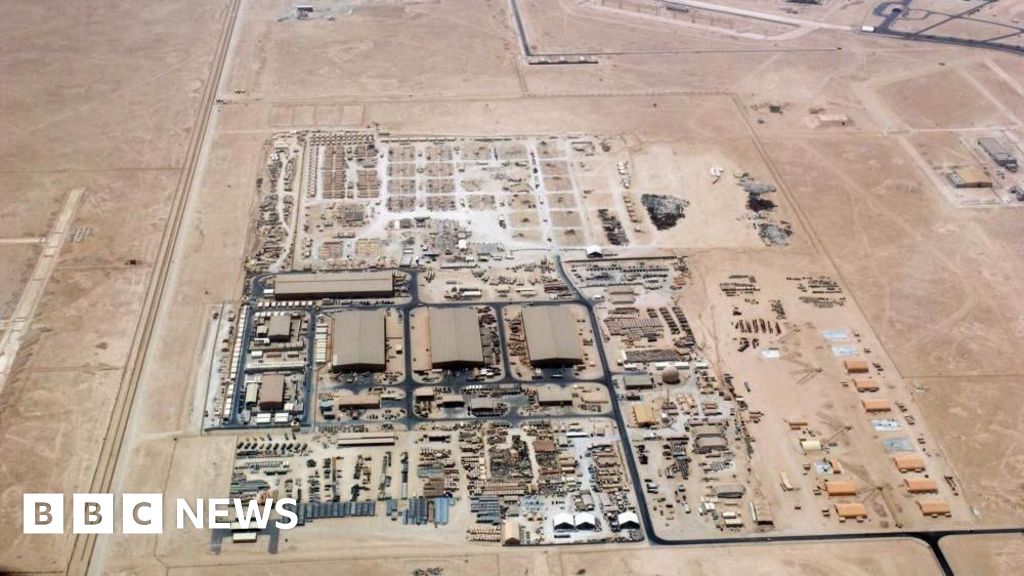
Reports indicate that Iran’s military has confirmed launching missile strikes targeting a United States military base in Qatar. The action is being presented by Tehran as a direct retaliation for recent American strikes, which Iran claims were directed at its nuclear sites. This development marks a significant escalation in the already volatile dynamics between the two nations and across the broader Middle East region.
The specific target of the Iranian missiles was identified as Al Udeid Air Base. Situated southwest of Doha, the capital of Qatar, Al Udeid is not merely a military installation; it is a critical hub for U.S. operations and coalition forces in the Middle East. It houses the forward headquarters of U.S. Air Forces Central Command (AFCENT) and is home to the Combined Air Operations Center (CAOC), which directs air campaigns across a vast area encompassing countries from the Horn of Africa to Afghanistan. The base hosts thousands of U.S. military personnel, along with forces from other allied nations, making it a high-value target both symbolically and operationally.
The Iranian statement frames the strikes as a response to American actions described as targeting “nuclear sites.” It is important to note that official U.S. reports on recent strikes against Iranian-linked targets in the region have typically focused on infrastructure, weapons depots, or personnel associated with groups attacking U.S. forces, rather than nuclear facilities. This framing by Iran could be intended to escalate the rhetorical aspect of the confrontation or signal a perceived threat to its strategic assets. Regardless of the exact nature of the preceding U.S. actions that triggered this response, the use of ballistic missiles directly against a major U.S. base represents a clear and potentially dangerous escalation in tactics.
The regional context for this incident is incredibly complex and fraught with peril. It unfolds against a backdrop of increased attacks by Iran-backed militias on U.S. personnel and facilities in Iraq and Syria, Houthi aggressions against shipping in the Red Sea, and the ongoing conflict in Gaza which has significantly heightened tensions between Israel and Hamas, drawing in regional proxies. The U.S. has conducted several retaliatory strikes against groups responsible for attacking its forces, including targets linked to Iran’s Islamic Revolutionary Guard Corps (IRGC) Quds Force. Tehran’s decision to strike a base in a relatively stable partner nation like Qatar, rather than continuing indirect attacks via proxies, signals a potential shift towards more direct confrontation.
Reporting from or even near military installations in the Middle East is an exercise in navigating complex layers of security, bureaucracy, and cultural nuances. I recall one instance during a past assignment in the region, attempting to gain proximity to a sensitive area near a base to observe local reactions. After hours of discussions at various checkpoints, mediated by multiple individuals who seemed to speak just enough English to misunderstand key details, I was finally granted what I thought was permission to proceed. Instead, I was led not towards the intended observation point, but to a small, air-conditioned tent where I was offered lukewarm tea and subjected to a surprisingly detailed, hour-long monologue from a very enthusiastic officer about the local falconry traditions. It was a moment of unexpected, slightly absurd interruption in the otherwise tense environment, a reminder that even in highly controlled military zones, the human element – and the potential for complete communication breakdown or cultural detours – is never far away. While certainly not “funny” in the conventional sense of humor surrounding the very serious events unfolding, these small, humanizing, or slightly bewildering moments are part and parcel of attempting to understand and report on life and operations in such challenging contexts.
The implications of the strike on Al Udeid are significant. Firstly, it tests the resolve of the United States and its commitment to protecting its forces and interests in the region. Any casualties or significant damage would necessitate a robust response, potentially triggering a cycle of escalation that neither side may fully control. Secondly, it puts Qatar in a delicate position. As a host nation to a major U.S. base while also maintaining diplomatic channels with Iran, Qatar walks a fine line. Attacks on its soil risk destabilizing its own security and its regional diplomatic standing. The Qatari government has yet to issue a comprehensive statement on the strikes, likely assessing the situation carefully.
As of the latest reports, details regarding the extent of damage at Al Udeid Air Base or potential casualties remain limited. Such information is often subject to security reviews before public release. The lack of immediate detailed reporting can add to uncertainty and speculation during these critical hours. The U.S. Central Command (CENTCOM) is expected to provide an assessment once the situation has been fully evaluated. Meanwhile, diplomatic efforts behind the scenes are likely already underway, involving regional partners like Qatar, seeking to de-escalate the situation before it spirals further out of control. The coming hours and days will be crucial in determining the immediate aftermath and the longer-term trajectory of U.S.-Iran tensions.
The strike on Al Udeid serves as a stark reminder of the inherent risks faced by U.S. forces stationed in the Middle East and the volatility of the current geopolitical landscape. Iran’s willingness to employ direct missile strikes against a central U.S. command node underscores its determination to respond forcefully to perceived provocations, elevating the risk of miscalculation and unintended consequences for all parties involved.