
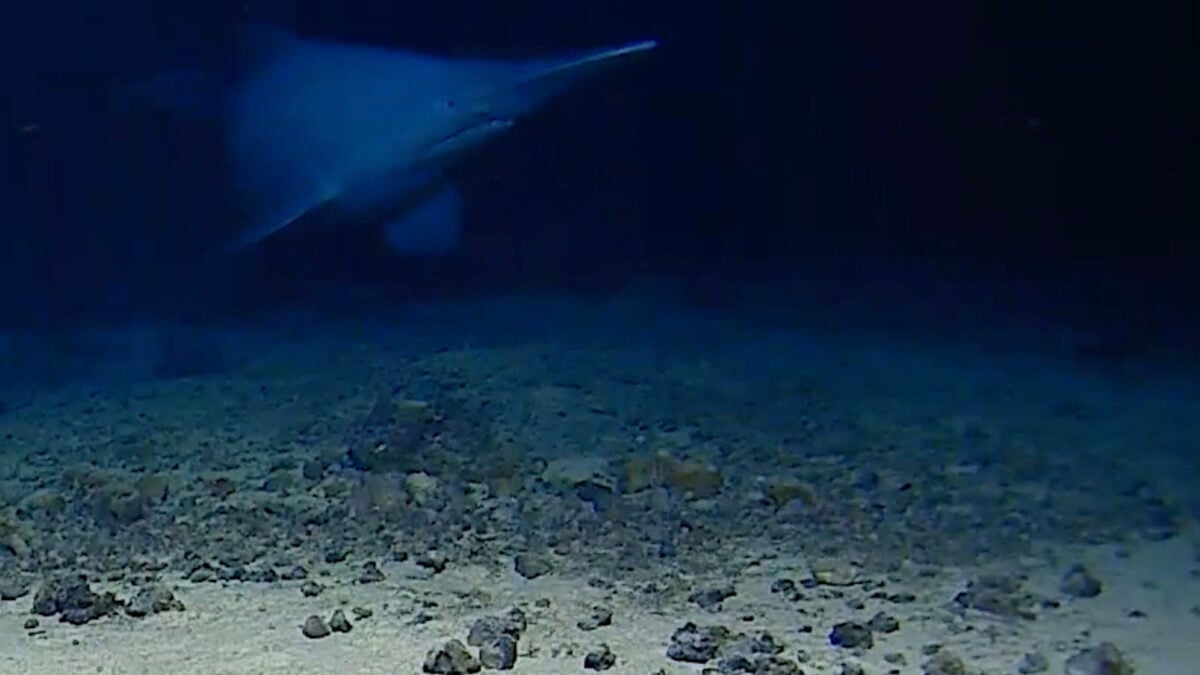
Imagine a world where time itself seems to curtsy, where evolution’s grand clock ticks at a different pace, preserving relics from eons past. Now, picture a creature from that very realm, a living fossil, finally stepping out from the deepest shadows to reveal its spectral form. That’s precisely what unfolded recently, a moment that sent ripples of wonder across the scientific community and captivated the imaginations of anyone who’s ever stared out at the ocean’s shimmering surface and pondered its profound mysteries. For the very first time, the enigmatic goblin shark, a creature so rare it borders on mythical, has been filmed alive and thriving in its natural, crushing habitat.
The Deep Unveiling: A Dance with an Ancient Mariner
This unprecedented encounter wasn’t a casual stroll in a coral garden. Oh no, this was an expedition into the very depths where sunlight is but a forgotten rumor. The goblin shark was captured on film at an astonishing 6,552 feet (1,997 meters) below the sea level, a realm where even light itself fears to tread. This was not just any patch of seabed; it was within the foreboding expanse of the Tonga Trench, a geological scar etched deep into the Earth’s crust northeast of New Zealand. To put that into perspective, this trench plunges deeper than Mount Everest reaches skyward, yet it’s still only the second-deepest ocean trench on our planet. Imagine the sheer audacity of this discovery, a momentary illumination in a world perpetually cloaked in obsidian black. It’s like discovering a dinosaur roaming freely in a forgotten valley, but this valley is an abyss, a colossal, unblinking eye staring back at the cosmos.
Anatomy of a Spectral Predator: The Goblin Shark’s Haunting Beauty
What makes the goblin shark such a mesmerizing spectacle? Its appearance alone is enough to etch it permanently into the gallery of nature’s most bizarre masterpieces. Often described as a “living fossil,” this creature is a direct descendant from a lineage stretching back some 125 million years. It boasts a distinctively elongated, flattened snout, a kind of biological proboscis that serves as a highly sensitive electroreceptive organ, allowing it to detect the faint electrical fields generated by prey in the perpetual gloom. When it’s ready to strike, its jaws, like a spring-loaded trapdoor, can protrude forward with unnerving speed, deploying rows of needle-sharp teeth that are perfectly adapted for seizing soft-bodied deep-sea prey. Its skin, a hauntingly beautiful and unusual pinkish-grey, is not merely a color; it’s a living camouflage, a reflection of its blood vessels showing through its translucent skin, a ghostly blush against the ink-black canvas of its home. It truly is an alien architect, a rose-tinted specter designed by the relentless sculptor of the deep.
The Tonga’s Embrace: A World of Crushing Pressure
The environment this magnificent creature calls home is utterly hostile by human standards. The Tonga Trench is a titanic monument to geological power, a testament to the Earth’s raw, untamed forces. At nearly 2,000 meters down, the ambient pressures are nothing short of monumental. We’re talking about an overwhelming force, a crushing embrace roughly around 2,900 pounds per square inch (PSI) – that’s equivalent to having the weight of a large car balancing on a single postage stamp, or imagining the immense force of deep-sea locomotives pressing down on every inch of your body. Any human traversing this domain without the most advanced submersibles would be instantly pulverized, flattened into an unfortunate memory. Yet, the goblin shark navigates this immense, unyielding wall of pressure with an effortless grace, its body exquisitely adapted to thrive where life seems impossible. It’s a true marvel of biomechanical engineering, a silent testament to nature’s boundless ingenuity in the face of extremity.
Why This Deep Dive Matters: Unlocking the Ocean’s Secrets
So, why is this single glimpse into the life of a pink-hued leviathan so profoundly important? Firstly, it’s a colossal triumph for deep-sea exploration. Filming anything at these depths requires technological titans – remotely operated vehicles (ROVs) or highly specialized submersibles, equipped with lighting powerful enough to pierce the abyssal darkness and cameras resilient enough to withstand the immense pressure. Each successful deployment is a cosmic ballet of engineering and human perseverance. Beyond the technical marvel, the scientific payoff is immense. Every piece of footage, every observation, is like finding a missing page from an ancient, sacred text. It provides invaluable data on the goblin shark’s behavior, its swimming patterns, its interaction with its environment, and even clues to its dietary habits. This information helps us piece together the intricate puzzle of deep-sea ecosystems, understanding how life adapts and flourishes in such extreme conditions, and offering insights into the broader tapestry of evolution.
Moreover, discoveries like this humble us. They remind us that despite our satellite eyes and digital fingers, vast stretches of our own planet remain largely unknown, echoing with mysteries yet to be unraveled. The deep sea is our final frontier, an ink-black canvas awaiting the brushstrokes of discovery. The goblin shark, with its ancient lineage and spectral beauty, serves as a poignant ambassador from this hidden world, urging us to continue our quest, to peer ever deeper into the planet’s beating heart. It’s a testament to the enduring wonder of nature and a powerful motivator for conservation, reminding us of the unfathomable treasures lurking beneath the waves, waiting for us to respectfully uncover their stories.
This single filming event isn’t just about a shark; it’s about the relentless human spirit pushing the boundaries of knowledge, shedding light on what was once thought unknowable. It’s about acknowledging that even in the most desolate corners of our world, life finds a way, adapts, and endures, often in forms more fantastic than our wildest dreams. The rose-tinted phantom has given us a fleeting, unforgettable glimpse, and in doing so, has deepened our appreciation for the astonishing diversity that thrives beneath the surface of our blue marble.